
Weatherbury Farm Grain Tracker

From Planting to Harvest, Appalachian Hard White Winter Wheat (Whole & Sifted Flour and Wheat Berries*) in the field:
*Wheat Berries are available seasonally

After the fields are plowed and harrowed (harrowing smooths the field after plowing), the Appalachian Wheat is planted.
(In the upper middle of the photo, you can see Weatherbury’s grass fed cattle grazing across the street).

Frost Seeding Appalachian Wheat
Appalachian Wheat is a winter planted grain. Most of our planting is done in the fall. This allows the crop to get a head start on weeds in the spring. With the wet weather in our area, this is a must. Winter planted grains need to vernalize over the winter to produce grain. If you were to plant it in the spring, it would just look like grass and not develop any grain.

The fields of Appalachian Wheat emerging from Winter. The plants have already begun to tiller and put forth multiple stalks per plant.

Across the street, you can see the bread oven which is being built (upper left hand of the photo). Perhaps the wheat has dreams of being a sourdough loaf. (We have dreams of eating that sourdough loaf!)

In just over three months, the Appalachian Hard White Winter Wheat has grown and the heads with grain growing in them can be seen.
In the front of the photo, you can see the frost seeded clover. The clover suppresses weeds, aids in holding up the grain, increases soil organic matter, and eventually provides nitrogen to the next crop

Appalachian Bread Flour in the field!
To the left (last year a grain field, this year a hay field) you can see the clover which was frost seeded in 2021.

Harvesting Appalachian Hard White Winter Wheat using our combine.

The Appalachian wheat grain is stored in the body of the combine. Straw comes out the back of the combine and is deposited back into field. The straw will be used to bed animals or left in the field to increase the organic matter of the soil.

Unloading the Appalachian Wheat into a gravity wagon. Aerators are then placed in the wagon to bring down the moisture of the grain. The grain is stored in the wagon until it is cleaned.
With visions of bread dancing in our heads!
Appalachian Wheat Facts 2022
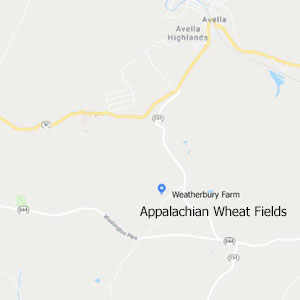
Appalachian Wheat Fields 2022
In 2022, Appalachian Hard White Winter Wheat was grown in Independence Township on our home farm. The farm is part of a 436 acre grant (known as Extravagance) surveyed to John Doddridge on April 6,1786. According to the Caldwell Atlas , the farm was established by M.T. Murdock in 1825. Murdock is listed as a farmer, grain, stock and wool grower (with 150 sheep). The farm was later a dairy operation (the Patterson family: 1945-1966) and a cattle operation (the Eastham family: 1966-1986). In 2008, we began raising historical grains on both the home farm and neighboring farms. The grains were certified organic in 2009 . In April 2014 Weatherbury Farm began stone-grinding flour. Weatherbury Farm also raised grass fed beef.
The wheat was planted on three fields totaling 8.27 acres on October 7, 2021 .
Clover was frost seeded into the wheat on March 5, 2022. (The clover suppresses weeds, aids in holding up the grain, increases soil organic matter, and eventually provides nitrogen to the next crop.)
The Appalachian Wheat was harvested on July 4,2022.
At the 2022 Washington County Fair, the Appalachian Wheat sheaf won 4th place and the jar of Appalachian Wheat grains won 1st place.
For an illustrated explanation of how Weatherbury grains become flour, visit the from seed to flour page.
About Appalachian Hard White Winter Wheat
Appalachian is a hard white winter wheat. Because the humidity in our area increases the incidence of disease in the fields, the eastern United States is not hospitable to growing hard white wheats. Luckily for us, North Carolina State developed Appalachian White Wheat which flourishes in our region.
Products Milled from Appalachian Wheat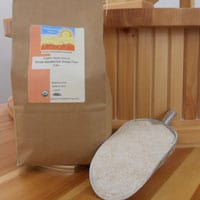
Appalachian wheat is milled into organic unbleached whole and sifted Appalachian bread flour.
Appalachian Hard White Winter Wheat Berries are available seasonally.
Health benefits of Wheat
Wheat is an excellent source of protein, dietary fibers, manganese and selenium. Wheat’s fiber boosts the digestive process and improves overall metabolism. The vitamin B content of wheat provides you with energy. Additionally, the complex carbohydrates in wheat keeps you feeling fuller longer and give you energy over a longer period.
Managanese, which wheat is rich in, acts as a co-factor for greater than 300 enzymes involved in the production of insulin and glucose secretion. Wheat’s betaine content prevents chronic inflammation, which is a key constituent in rheumatic pains and diseases. Additionally, its anti-inflammatory property reduces the risk of ailments like osteoporosis, heart diseases, Alzheimer’s disease, cognitive decline, and type-2 diabetes.
More Information
Appalachian bread flour and wheat berries can be ordered either for our monthly on-farm pickup or you can have your order sent to you.
To read more about Appalachian bread flour, please visit our products page.
More information on Appalachian Hard White Winter Wheat and other grains grown at Weatherbury Farm are on the grains we grow page.