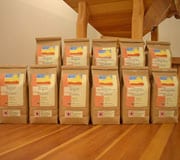
Organic Whole & Sifted Maxine Bread Flour
Stone-milled to order at Weatherbury Farm from Organic Maxine Hard Red Winter Wheat which is grown on the farm

Stone-milled to order at Weatherbury Farm from Organic Maxine Hard Red Winter Wheat which is grown on the farm
Bread made with Maxine Flour has been called “life affirming” by eater.com.
Maxine Flour gives a hearty European type flavor to baked goods from breads to rolls, pizza crusts, and pasta
 Milled to order from Organic Maxine Hard Red Winter Wheat grown at Weatherbury Farm.
Hearty Flavor. Ground in one pass and sifted through a very coarse sieve so that any very large pieces of bran are removed. Hearty stone-ground flour with only the coarsest bran removed.
Contains the minerals, vitamins, enzymes, amino acids, fiber and oils in the same proportions as they are found in the grain.
This flour is not bleached.
2 lbs* ($5.26); 5 lbs* ($10.12); 20 lbs ($34.41); 25 lbs ($41.03); 50 lbs** ($78.90)
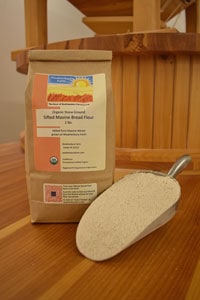 Milled to order from Organic Maxine Hard Red Winter Wheat grown at Weatherbury Farm.
Similar to commercial 85% extraction flour. The germ is still in the flour and there are some small pieces of bran. Sifted through a fine sieve and ground in multiple passes. The flour contains the grain’s natural flavor and has a golden color.
This flour is not bleached.
2 lbs* ($8.23); 5 lbs* ($15.83); 20 lbs ($53.67); 25 lbs ($63.14); 50 lbs** ($121.42)
* 2 and 5 pound bags are packaged in re-sealable bags .
** 50 pound bag cannot be shipped.
One pound of flour equals approximately 3 cups of flour.
Please place your order for all of Weatherbury’s products, including Maxine Bread Flour, through our on-line shop.
Current product availability can also be checked at the shop.
Please Note: Maxine makes a flavorful sourdough bread, which may be denser than the sourdough bread you may be used to. Please see our article on baking sourdough bread with Weatherbury Farm Flours. Our Glenn bread flour provides the loftiest sourdough loaf of all our flours.

Fields of Maxine Wheat alternate with hay fields
Weatherbury Farm’s Maxine Wheat Tracker traces the the Maxine Hard Red Wheat (that is milled into flour) back to the field where it was grown, here at Weatherbury Farm.
Weatherbury Farm is one of a handful of farms that produces local flours (flour milled from grains grown on the farm). But we take it a step further and provide, through our grain tracker, complete traceability — information & pictures of how, when, and where the grain was grown.
Imagine serving bread made with Maxine Bread Flour and to the “oohs” and “aahs” of your guests, you pull out your cell phone and click on Weatherbury’s Maxine Wheat Tracker and say “Let me show you the bread in the field. Here is the grain was grown that was milled into the flour from which the bread was made.”
Use in: breads (pan, quick & sourdough), rolls, muffins, bagels, crackers, pizza crusts, and pasta.
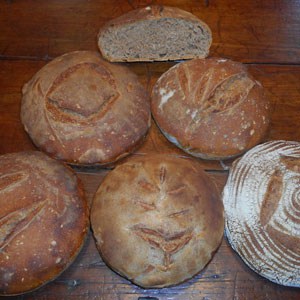
Sourdough Bread made with Weatherbury’s Maxine Flour
Weatherbury’s recipe book which is included with your first order has our personal favorite recipes.
Sourdough Bread: Included in our cookbook is a sourdough recipe which works well with Weatherbury’s stone-milled flours. If you are using your own recipe, we recommend that you start with a hydration of 70% or less.
Sourdough bread made with Maxine Bread Flour may be more dense than the sourdough bread you are used to but it has a hearty European flavor. Of the flours we offer, Glenn Bread Flour makes the loftiest sourdough bread. You might enjoy reading this article on making sourdough bread with Weatherbury Farm Flours.
Both the terroir of the soil and the fact that our Maxine bread flour is stone-milled give the flour its wonderful hearty flavor. Eater.com calls bread made with Maxine Bread Flour “life affirming.”
You can substitute 100% Weatherbury Maxine Bread Flour for bread flour or all-purpose flour in recipes for bread, rolls, muffins, etc.
When you use Weatherbury Maxine Bread Flour in your baked goods, you not only enhance the taste but make them more nourishing.
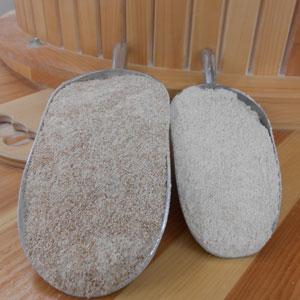
Whole and Sifted Maxine Bread Flour
Wheat is an excellent source of protein, dietary fibers, manganese and selenium. Wheat’s fiber boosts the digestive process and improves overall metabolism. The vitamin B content of wheat provides you with energy. Additionally, the complex carbohydrates in wheat keeps you feeling fuller longer and give you energy over a longer period.
Managanese, which wheat is rich in, acts as a co-factor for greater than 300 enzymes involved in the production of insulin and glucose secretion. Wheat’s betaine content prevents chronic inflammation, which is a key constituent in rheumatic pains and diseases. Additionally, its anti-inflammatory property reduces the risk of ailments like osteoporosis, heart diseases, Alzheimer’s disease, cognitive decline, and type-2 diabetes.
And best of all, it tastes great.
There are no preservatives in our flour. Please refrigerate. If you will not be using the flour immediately, please store in the freezer especially in warm weather.
Historically, hard wheat was not grown in southwestern Pennsylvania because of our wet weather. In fact, bread was made from soft wheat (what we think of today as a pastry flour). Maxine was the first hard wheat we planted at the farm. It was developed c1980 by Dr. Peter Franck (PZO Pflanzenzucht Oberlimpurg) of Germany and works quite well here.
Today’s wheat ( Triticum aestivum ) can be traced back to domesticated forms of spelt (T. spelta) . Because spelt does not thresh free from the hull, farmers/ plant breeders in the 1800s selected and planted spelt grains that did thresh free and by continuing to do this over a period of time, a free-threshing wheat developed.
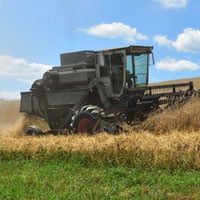
Harvesting Maxine Wheat at Weatherbury Farm with our Gleaner Combine.
In the early 20th century, the laws of Gregor Mendel were applied to wheat breeding. This produced wheats with a thick bran that were bred to withstand chemical fertilizers, herbicides and pesticides and could stand up as well to the harsh roller milling processing necessary to produce loaves and loaves of “white bread.” Because of global market pricing, breeders of this type of wheat strive to have the lowest cost of production possible.
For both organic systems and also stone milling of flour, wheat varieties with a thinner bran work better than the above modern wheats with a hard bran. Not all breeders look to breed wheat that will stand up to roller mills and produce “white bread.” It is those wheats that are used in today’s organic production.
During harvest, the wheat kernels thresh free of the chaff from the grain head and don’t require an extra dehulling step like spelt, emmer or einkorn. Before milling, the grain is cleaned to remove any remaining chaff, straw pieces or weed seeds.