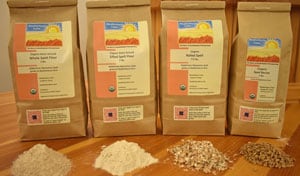
Organic Rolled Spelt
Rolled to order at Weatherbury Farm from Oberkulmer Spelt which is grown on the farm

Rolled to order at Weatherbury Farm from Oberkulmer Spelt which is grown on the farm
Oberkulmer Spelt is an old Swiss landrace, a pure spelt with no modern wheat genetics.
Prized for its superior nutrition, Weatherbury’s rolled spelt offers a new dimension for breakfast and for use in other recipes.
 Rolled to order from Oberkulmer Spelt grown at Weatherbury Farm.
A great way to add a tasty ancient grain to your diet.
1.5 lbs* ($5.78); 5 lbs* ($13.08)
Please place your order for all of Weatherbury’s products, including Rolled Spelt, through our on-line shop.
Current product availability can also be checked at the shop.
Limit 15 lbs. per order
* 1.5 and 5 pound bags are packaged in re-sealable bags .
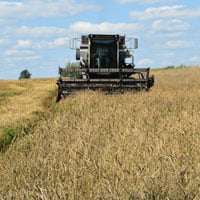
Harvesting Oberkulmer Spelt
Weatherbury’s Spelt Tracker traces the Oberkulmer Spelt grain that is rolled into rolled spelt back to the field where it was grown, here at Weatherbury Farm.
Weatherbury Farm is one of a handful of farms that produces local rolled products (rolled from grains grown on the farm). But we take it a step further and provide, through our grain tracker, complete traceability — information & pictures of how, when, and where the grain was grown.
When you serve Weatherbury’s Rolled Spelt either as a delicious breakfast cereal or use it in making pancakes, cookies etc., you can pull out your cell phone and click on Weatherbury’s Oberkulmer Spelt Tracker and let folks see the spelt in the field.
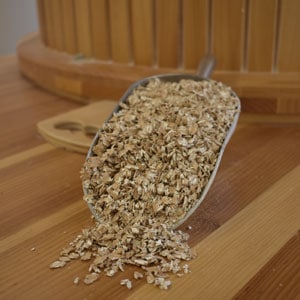
Organic Rolled Oberkulmer Spelt
Weatherbury’s rolled spelt offers a new dimension for breakfast and for use in other recipes.
Rolled spelt can be used to add depth to pancakes and in many baked goods from scones to muffins.
The terroir of the soil gives our rolled spelt its wonderful flavor.
For quick breads (like banana), pancakes, cookies and muffins, you can add Weatherbury’s Rolled Spelt to the flour to enhance the flavor of the bread.
You can also substitute rolled spelt 1 to1 for other flaked grains.
When you use Weatherbury’s Rolled Spelt as a breakfast cereal or in baked goods, you are sure to get comments about their great flavor. You needn’t tell the family that they are also more nourishing because they are rolled “live”.
Oberkulmer Spelt, a Swiss landrace with no wheat genetics; it has not been hybridized as many newer spelt varieties have been.
Spelt is one of the healthiest foods. Prized for its superior nutrition, spelt is higher than wheat in protein, minerals and vitamins and lower in calories than wheat. It is gentle for the whole digestive tract and strengthens your immune system and your nerves. With a gluten entirely different from wheat, spelt imparts a nutty flavor.
Nutrient rich, spelt contains all nine amino acids essential to human health. It also has significant levels of B-complex vitamins, vitamin E, vitamin K, copper, manganese, potassium, iron, zinc, niacin, phosphorous, and selenium. Spelt is low in sodium, saturated fat and cholesterol and is a good source of fiber.
Weatherbury’s spelt is rolled “live” and not steamed as in commercial production. Raw rolled spelt preserves the nutrients and enzymes of the whole grain thus offering more nourishment.
And best of all, it tastes great.
There are no preservatives in our rolled spelt. Please refrigerate. If you will not be using the rolled spelt immediately, please store in the freezer especially in warm weather.
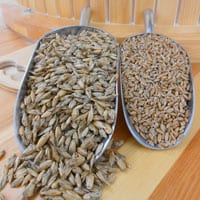
Spelt in the hull and spelt berries (after being dehulled)
Spelt is one of the three ancient grains. (Weatherbury Farm also grows the other two, einkorn and emmer.)
According to Greek mythology, spelt is a gift from the goddess of harvest, Demeter (when you taste it, you will no doubt agree). Mentioned in the bible (Exodus 9:32, Isaiah 28:25 & Ezekiel 4:9), cultivation of spelt goes back thousands of years to the Bronze Age. Estimates are that it was cultivated in the fertile crescent starting between 9000 and 5000 years ago.
Spelt remained a staple crop in Europe through the end of the 19th century. St. Hildegard (1098-1179) of Bingen (Germany) extolled spelt’s virtues. Today it is most widely used in Germany where it is known as “Dinkel” and Italy, “Farro Grande.”
Spelt arrived in the United States in the late 1800s, but common wheat replaced it in the 20th century. Recently, however, the artisanal and organic movements have revived interest in spelt, not only because it is nutritious, but because of its lovely flavor.
Oberkulmer Spelt, a Swiss landrace, has not been crossed with wheat and is recognized for its high genetic purity. Spelt that has been crossed with wheat has higher yields but raises the question if the characteristics of ancient spelt are present in these varieties.
Oberkulmer Rotkorn (its full German name) was collected and distributed under the auspices of Dr. Peter Franck (PZO Pflanzenzucht Oberlimpurg).
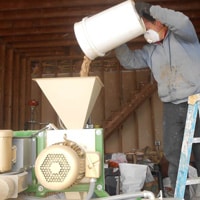
Dehulling Spelt with Farmer Nigel’s dehuuler
Spelt (Triticum aestivum var. spelta) is a member of the wheat family but has a hard outer hull that protects it from the weather and from insects in storage. Unlike wheat, the hull is not removed during harvest and needs to be removed before it can be milled. Luckily for Weatherbury Farm, Farmer Nigel has built a spelt dehuller to do this job.
As a member of the wheat family, Spelt does have gluten (which can be likened to a glue that holds food together) but spelt’s gluten is different from the gluten in wheat. Gluten, a complex protein, has two parts – gliadin, which gives dough stretchiness and glutentin that provides elasticity and structure. In wheat, these two simpler proteins are in balance; however, spelt has a higher gliadin to glutenin ration.
Some people who have a wheat allergy or gluten sensitivity report that they are able to eat rolled spelt. However, people with gluten allergies, gluten intolerance or celiac disease should not use it.