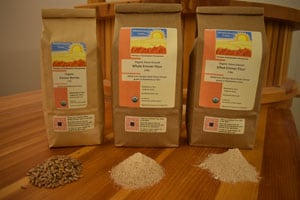
Organic Obsidian Emmer Flakes : An Exclusively Weatherbury Grain
Rolled to order at Weatherbury Farm from Organic Obsidian Black Winter Emmer which is grown on the farm.

Rolled to order at Weatherbury Farm from Organic Obsidian Black Winter Emmer which is grown on the farm.
An ancient grain for modern times.
Join the Porridge Eaters who have conquered the world!
 Rolled to order from Obsidian Emmer grown at Weatherbury Farm.
Weatherbury Farm might be the only seller of Emmer Flakes in the Americas! We found emmer flakes sold in Estonia, Germany and Serbia on the web, but nothing closer. We certainly can’t understand it because they are not only nutritious but really delicious.
1.5lbs* ($9.33); 5lbs* ($20.82)
Please place your order for all of Weatherbury’s products, including Emmer Flakes, through our on-line shop.
Current product availability can also be checked at the shop.
Limit 15 lbs. per order
* 1.5 and 5 pound bags are packaged in re-sealable bags .
 Emmer is an ancient grain. Grown at Weatherbury Farm, which is the first farm to offer complete traceability back to the field where it was grown.
Weatherbury Farm’s Emmer Tracker traces the Obsidian Emmer grain that is rolled into Emmer Flakes back to the field where it was grown, here at Weatherbury Farm.
Weatherbury Farm is one of a handful of farms that produces local rolled products (rolled from grains grown on the farm). But we take it a step further and provide, through our grain tracker, complete traceability — information & pictures of how, when, and where the grain was grown.
When you serve Weatherbury’s Emmer Flakes either as a delicious breakfast cereal or use it in making pancakes, cookies etc., you can pull out your cell phone and click on Weatherbury’s Obsidian Emmer Tracker and say to the folks at the table “Emmer is the one of the world’s oldest grains and it is grown at Weatherbury Farm. Take a look at the grain in the field.”

Weatherbury’s Obsidian Emmer Flakes
Emmer Flakes, which are similar to Rolled Oats, can be used in a variety of dishes. While the flakes make a great start to your day, don’t forget to think beyond porridge for breakfast to using the flakes in pancakes, breads, scones and muffins or a thickener for soups and stews.
Our recipe for emmer porridge is on the package back.
The terroir of the soil gives the rolled emmer flakes its wonderful flavor.
For quick breads (e.g. banana), pancakes, cookies and muffins, you can add Weatherbury’s Emmer Flakes to the flour to enhance the flavor.
You can also substitute emmer flakes 1 to1 for other flaked grains in a recipe. And emmer flakes make a great addition to granola or muesli.
When you use Weatherbury’s Emmer Flakes as a breakfast cereal, as granola or in baked goods, you are sure to get comments about their great flavor.
If you use Weatherbury Emmer Flakes, you not only enhance the taste of the baked goods but make them more nourishing,
Emmer wheat is also known as Khapli wheat in India and is known as Farro in Italy.

Emmer Flakes / Rolled Emmer — available from Weatherbury Farm!
Weatherbury Farm rolls emmer from Obsidian Emmer, which was bulked at Weatherbury Farm.
Emmer contains only 28 chromosomes while modern wheat contains 42.
Emmer is high in protein — 1/2 cup contains between 26 and 40% of the daily fiber requirements. And as a high protein, low gluten grain emmer may be easier to digest. As Emmer is easier to digest, it may help with your body’s metabolism and weight control. In addition to fiber and protein, it contains high levels of minerals (copper, magnesium, manganese, phosphorus, zinc, iron & selenium), vitamins (B&E), anti-oxidants (especially lignans) and essential fatty acids that can help keep you healthy. Additionally, it has a low glycemic index.
As the emmer flakes are rolled “live” and not steamed, they retain higher vitamin levels (in particular, B vitamins) and antioxidants that heat can destroy.
And best of all, it tastes great.
There are no preservatives in our flour. Please refrigerate. If you will not be using the flour immediately, please store in the freezer especially in warm weather.

Horus (right) oversees plowing. The Temple of Horus at Edfu, Egypt.
Join the ranks of the Roman Legion who conquered the world as they knew it. Romans brought emmer home after invading Egypt in 47BC. and emmer porridge was the standard daily ration of the Roman legion.
Wild emmer has been carbon dated back to 17000BC at Ohalo II (an archaeological site on the sea of Galilee in Israel). Emmer is one the “founder crops,” being one of the first cereals to be domesticated. Evidence that it was cultivated for over 7000 years was found near Damascus.
Emmer was important in ancient Egypt where it was used to make bread and beer. As bread and beer were the staples of life, growing emmer (as well as the barley used in beer making) was at the center of the entire agricultural economy of Egypt.
During the new kingdom (c. 1570- c. 1069 BC) it was also used to pay wages and taxes. Additionally, for Egyptians, emmer was part of religious ceremonies. Representations of growing, harvesting and baking with emmer can be seen in Egyptian temples and tombs.

Emmer in Tiberias, Israel. Tiberias is located on the Sea of Galilee about 5 miles from Kinneret, the location of the Ohalo II archeological dig. Wild emmer seed found at Ohalo has been carbon dated back to 17000BCE.
Emmer is thought to be the wheat of the bible. In Hebrew, the word for emmer and spelt is the same; however, spelt was not grown in ancient Israel.
Following the Roman conquest of Egypt, the Romans increasingly used emmer (farro), to feed its population. Emmer was called the “Pharaoh’s Wheat” by Julius Caesar.
Emmer is the predecessor of Durum Wheat.
Today, wild emmer is still seen growing in the fertile crescent.
The use of emmer has recently enjoyed a resurgence. The emmer grain is also known as farro medio and in the US, considered the farro of choice. Farro medio is most often pearled. Currently, Nigel is working on the development of a pearling machine. The term “farro” comes from “Pharaoh’s Wheat.”
Emmer is one of the three ancient grains. (Weatherbury Farm also grows the other two, spelt and einkorn.)
Even today, Emmer can be found growing wild in Israel.

Emmer at Agritechnica 2011
At Weatherbury Farm, we grow Obsidian Black Winter Emmer. The emmer is a variety that we got 12 seeds of at Agritechnica in Germany in 2011. We started bulking the seed in 2012, by planting increasingly larger test plots. By 2018 we had a 1/3 of an acre planted. That was a unfortunately a very wet year and we lost the whole crop.
In the fall of 2020, we planted a large plot to start bulking our seed back up again. On October 14, 2021 we planted .248ha/.613ac of the Obisdian Black Winter Emmer and harvested it on July 24 2022. Emmer has been part of our yearly grain plantings ever since.
Emmer (Triticum dicoccum) has survived for 17,000 years. It’s hard outer hull (that protects it from the weather and from insects in storage) has helped emmer last long in its desert areas of origin.
Wheat hulls are not removed during harvest. Emmer’s hulls are not.
Like Einkorn, the emmer hull is surrounded by tiny “hairs”. So, before the emmer can even be cleaned, the “hairs” must be removed by a debearder. After the emmer is debearded it is cleaned but the hull still needs to be removed before it can be milled. Luckily for Weatherbury Farm, Farmer Nigel has built a dehuller to do this job.
Emmer, like the other ancient wheats of einkorn and spelt does have gluten. The two parts of gluten — gliadin, which gives dough stretchiness and glutentin, which provides elasticity and structure are in balance in wheat. However, emmer has a high gliadin to glutentin ratio.
Some people who have a wheat allergy or gluten sensitivity report that emmer is easier to digest. However, people with gluten allergies, gluten intolerance or celiac disease should not use it.

Debearding Emmer

Emmer after Debearding

Dehulling Emmer (using dehuller built by Farmer Nigel)

Emmer after dehulling (ready for milling)