Organic Wapsie Valley Cornmeal and Polenta

Stone-milled to order at Weatherbury Farm from Open Pollinated Wapsie Valley Corn which is grown on the farm.

Cornbread made with Weatherbury’s cornmeal and sifted pastry flour has won first, second or third place in the county fair eight out of the past nine years.

Weatherbury’s open pollinated Wapsie Valley Corn packs both a visual and a flavor punch.

Organic Wapsie Valley Cornmeal

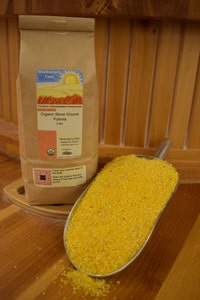
Wapsie Valley Cornmeal in Bag • Weatherbury FarmMilled to order from Wapsie Valley Open Pollinated Corn (c. 1850) grown at Weatherbury Farm.

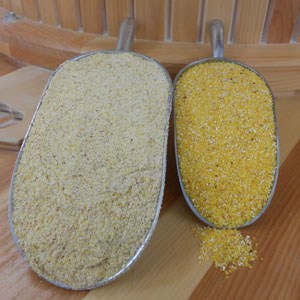
More finely ground than polenta.  Yellow with some red flecks. Milled at a low temperature, it maintains the nutrients and flavor of the organic open pollinated non-GMO corn.

Contains the minerals, vitamins, enzymes, amino acids, fiber and oils in the same proportions as they are found in the grain.

2 lbs* ($4.86); 5 lbs* ($9.35); 20 lbs ($32.73); 25 lbs ($38.51); 50 lbs** ($74.05)

Organic Wapsie Valley Polenta

Wapsie Valley Polenta in Bag • Weatherbury FarmMilled to order from Wapsie Valley Open Pollinated Corn (c.1850) grown at Weatherbury Farm.

Coarsely ground, mainly yellow but with red flecks that make it visually interesting. The flavor is enhanced because it is stone ground from an open pollinated, non-GMO corn.  Unlike hominy grits, our polenta is not treated with lye.

Contains the minerals, vitamins, enzymes, amino acids, fiber and oils in the same proportions as they are found in the grain.

2 lbs* ($8.48); 5 lbs* ($16.30)

* 2 and 5 pound bags are packaged in re-sealable bags.
** 50 pound bags cannot be shipped.

One pound equals approximately 3 cups.

Please place your order for all of Weatherbury’s products, including Cornmeal & Polenta, through our on-line shop.
Current product availability  can also be checked at the shop.

Please note: While corn has no gluten, Weatherbury’s cornmeal and polenta are milled on the same mill we use to mill flour.  While there is a vigorous cleanout between types of grain, some wheat flour could remain; thus it cannot be considered gluten free.

6.21.22 Cultivating Wapsie Valley Corn • Weatherbury Farm

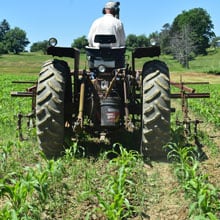
Cultivating corn at Weatherbury Farm

Wapsie Valley is a heritage open pollinated (c.1850) and can be traced back to field where it was grown.

Weatherbury’s Wapsie Valley Corn Tracker  traces the Wapsie Valley Corn is milled into cornmeal and polenta back to the field where it was grown, here at Weatherbury Farm.

Weatherbury Farm is one of a handful of farms that produces locally milled products (products milled from grains grown on the farm).  But we take it a step further and provide, through our grain tracker, complete traceability — information & pictures of how, when, and where the grain was grown.

So you’ve baked cornbread or are serving polenta and say to the folks at the table, as you pull out your cell phone and click on Weatherbury’s Wapsie Valley Corn Tracker  “Wapsie Valley Corn is a heritage open pollinated corn that it is grown at Weatherbury Farm.  Take a look at the grain in the field.”

Using Weatherbury Wapsie Valley Cornmeal and Polenta

Organic Cornmeal and Polenta • Weatherbury Farm

Organic Cornmeal and Polenta

Use cornmeal in bread, muffins, cakes , pancakes, johnny cakes, hush puppies, dressing, stuffing, spoon pudding.

Serve polenta warm with butter and/or cheese.  Or let it set up to use as polenta in another recipe.

How to substitute Wapsie Valley Cornmeal and Polenta in your own recipes

You can substitute Weatherbury’s cornmeal or polenta in any recipe calling for cormeal or polenta.  The only difference is that it will taste better than before.

Weatherbury’s cornmeal package back has the recipe for making our award-winning cornbread.  On the back of the polenta package, you will find our recipe for making polenta.

When you use Weatherbury’s Wapsie Valley Cornmeal and Polenta, you not only enhance the taste but make your food more nourishing.

Benefits of  Wapsie Valley Cornmeal and Polenta

Weatherbury Farm mills cornmeal and polenta from Wapsie Valley Corn, an American open pollinated heritage corn.

Corn is a rich source of vitamins A,B,E and minerals (phosphorus, magnesium, manganese, zinc, iron and copper).  With a high fiber content, it plays a significant role in preventing digestive ailments. It is rich in phytochemicals which provides protection against a number of chronic diseases, such as Alzheimer’s.

And best of all, it tastes great.

Storing Wapsie Valley Cornmeal and Polenta

There are no preservatives in our milled products.  Please refrigerate.  If you will not be using the Cornmeal or Polenta immediately, please store in the freezer especially in warm weather.

1st place Cornstalk Washington County Fair 2022 • Weatherbury Farm

Weatherbury’s cornstalks have won one first place in 2025, 2022, 2021, 2017 and 2016 — beating all the GMO corn in the county.

Award winning cornbread · Made with Weatherbury's cornmeal and pastry flour

And as to taste — cornbread made with Weatherbury’s cornmeal and pastry flour has placed at the county fair 9 out of the past 10 years, winning 4 First place awards and 3 Second place award and 2 Third place awards.

More Information about Wapsie Valley Cornmeal and Polenta

History of Corn and Wapsie Valley Corn

About 8500 years ago, the wild grass plant teosinte was domesticated in Mexico.   To grow it, the hunter gatherers needed to remain in villages from sowing to harvesting.  That corn, like today’s cornmeal and polenta was not eaten fresh, but was dried on the stalk and ground to be used in baking tortillas and other foods.  Corn was brought up the Mississippi River by native Americans.  It was introduced into Europe by Christopher Columbus.

While the earliest corn plant was quite small, selective breeding by Native Americans, farmers, and scientists, has changed it into the today’s corn plant.

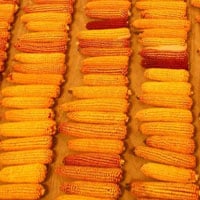
At Weatherbury Farm, we grow open-pollinated Wapsie Valley Corn. Wapsie Valley Corn is an open-pollinated heirloom corn which  dates back to the 1850s.  It is a two-color corn, producing ears of either all coppery red or all dark yellow kernels. The corn is named for the Wapsipinicon River, located in the Wapsie Valley region in Iowa.

Wapsie Valley Corn — the grainWapsie Valley Corn · Weatherbury Farm

Wapsie Valley Corn is an open-pollinated heirloom dent corn which  dates back to the 1850s.  It is two-color corn, producing ears of either all coppery red or all dark yellow kernels.

Corn is a spring planted crop.  Because Weatherbury Farm is organic, we rotary hoe and cultivate the corn to lessen the impact of weeds.

Wapsie Valley Corn is classified as a dent corn because most of its kernels have a small indentation.  Some of the kernels, however, have no indentations similar to flint corn.